Applications Open for Community Health Accelerator 2025 Cohort

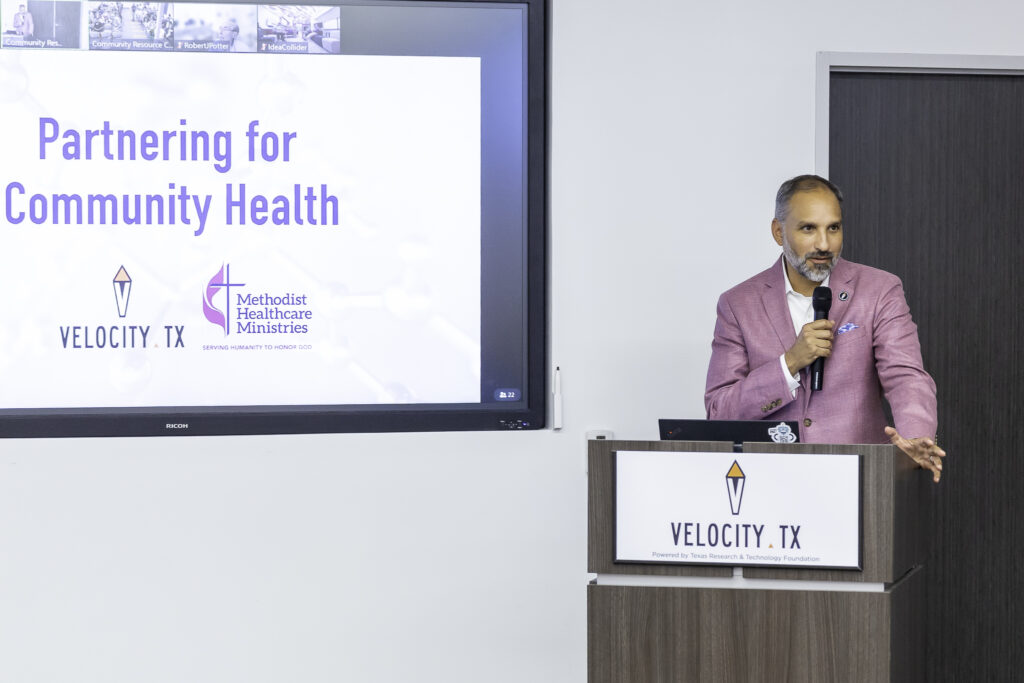
SAN ANTONIO (March 26) – VelocityTX, the Eastside innovation hub and economic development organization, announced today the opening of applications for the 2025 cohort of its Community Health Accelerator, a specialized program designed to advance startups focused on commercializing solutions that address the social determinants of health (SDOH).

Launched in 2023, the annual accelerator is the cornerstone of a multi-year partnership with Methodist Healthcare Ministries of South Texas, Inc. (MHM). “The Community Health Accelerator is propelling innovation and sustainable solutions at the intersection of business and community impact that can transform healthcare delivery for those most in need,” said MHM President and CEO Jaime Wesolowski. “We are excited to see what the 2025 applicants will bring to the table as we seek to address the social determinants of health and advance health and wellness in communities across South Texas.” 

Conducted over eight weeks beginning in August, the Community Health Accelerator will provide founders with resources and training to help navigate the challenges of early-stage growth. The program offers classroom-style business training and operational guidance, and each participant will receive personalized mentoring and pitch coaching from local business leaders.

The program culminates in a public Demo Day, where the five companies selected for the cohort will showcase their innovations for a panel of judges.

“The Community Health Accelerator is a first-of-its-kind program and we are excited that San Antonio is leading the conversation around this critical area of healthcare,” said Rene Dominguez, President and CEO of VelocityTX. “Our 2024 cohort represented some of the most innovative companies from across North America, and we look forward to helping advance a new class of social entrepreneurs to the forefront.”

The program’s 2024 winner, Dallas-based Yumlish, recently launched a community pilot of their technology in the Rio Grande Valley, where they hope to combat diabetes with their culturally-relevant nutrition management platform. “We have worked hard to create an accessible solution for Spanish-speaking communities, and we are so excited about the impact Yumlish will have in the Rio Grande Valley,” said Founder and CEO Shireen Abdullah.

Companies interested in applying to the Community Health Accelerator may do so here. Applications will close on June 15, 2025.

###

About Methodist Healthcare Ministries of South Texas, Inc.
Methodist Healthcare Ministries broadens the definition of healthcare by providing low-cost clinical care for the uninsured and by supporting community-led efforts that improve living conditions that cause people to be sick in the first place. We use our earnings as co-owners of Methodist Healthcare to ensure that people who are economically disadvantaged and uninsured can live their healthiest lives. We do this by advocating for, investing in and providing access to quality clinical care and addressing factors that affect health—including economic mobility, supportive relationships, food security, broadband access, and safe neighborhoods. Ultimately, we fulfill our mission of “Serving Humanity to Honor God” by advancing health equity so that more resilient individuals & families living in the 74 counties we serve can thrive.

About VelocityTX
Formerly known as the Texas Research & Technology Foundation, VelocityTX is a nonprofit organization established in 1984 to promote sustainable economic and community growth. In carrying out this mission, the organization seeks to advance San Antonio’s life sciences industry through the development of a state-of-the-art bioscience innovation campus on the city’s near east side. Based out of the former Merchants Ice & Cold Storage complex, the master planned development will bring together established bioscience companies, healthcare startups, and military medical research organizations in an inclusive community where ideas collide to spur medical breakthroughs. VelocityTX also promotes workforce development through its Step Into STEM program, and provides entrepreneurial support services designed to accelerate the commercialization of emerging medical technologies. Learn more at velocitytx.org.

Capacity Building Series: Board Member Engagement – Relationship Mapping

See our previous blog on Growing Board Fundraising Engagement

Prospective Donors (Find, Cultivate, Maintain, and Retain Relationships) 

Finding new donors can be difficult: knowing where to start, where to look, how to find them. If you start with who you already know and those who are already passionate about and invested in your mission, then they can lead you to potential donors. A great place to start is with your current board members who have a responsibility to contribute to fundraising.

Why Lean on Your Board’s Relationships? 

Board members are already advocates because they know about the mission and work and are likely current donors. Who better to help you find and cultivate new donors? 

What is Relationship Mapping? 

It’s mapping out who your board members know, or the connections and relationships they have. The focus should be on people or businesses board members have potential influence with and determine who could potentially benefit your organization’s mission. 

Relationship mapping tracks these connections to provide data to help: 

  • Identify potential champions and advocates of your mission (e.g. volunteers) 
  • Expand your marketing 
  • Evaluate the potential for campaigns 
  • Secure corporate sponsors/partners 
  • Raise money 

How to Introduce Relationship Mapping to Board Members 

This can be a delicate process. Be mindful that many people hesitate to offer up people they know will be asked for donations. Ask them why they joined the board and chose to support your organization. Then remind them their support is crucial in meeting your goals, accomplishing your mission, and serving your community. 

Help them tap into the emotion that led them to become involved in your organization in the first place. Help them get more comfortable with the idea of expanding their circle of influence and ask for their help with it. Show them you will walk alongside each other in the journey and work together. 

Next, be sure to communicate clearly about the goal—whether it’s finding raffle items for an event or donors for a capital campaign—so you can be specific about who or what you’re looking for. For example, small business owners who can donate items to be raffled off or corporate leaders who could potentially approve major gifts. The relationship with your donors can be mutually beneficial, so consider sharing how this donation can benefit them as well such as special events or business marketing through sponsorships. 

If you have few or limited donors, try having board members map out as many contacts in their circle of influence as they can, such as from: 

  • Social circles 
  • Other nonprofits they’re board members of 
  • Business connections 
  • Alumni groups or organizations 
  • Faith-based groups or churches 

Be sure to have them provide more than just names. You’ll want to have a profile of each person, so you know more about them and how to approach them. You might ask them to include how they’re connected with each person, what their interests and passions are, perhaps their giving history and priorities, how they prefer to interact or be contacted, and of course, their contact information. In many cases, people will prefer to hear directly from someone they’re already connected with, but these profiles can help make approaching their contacts easier for board members or for your staff. 

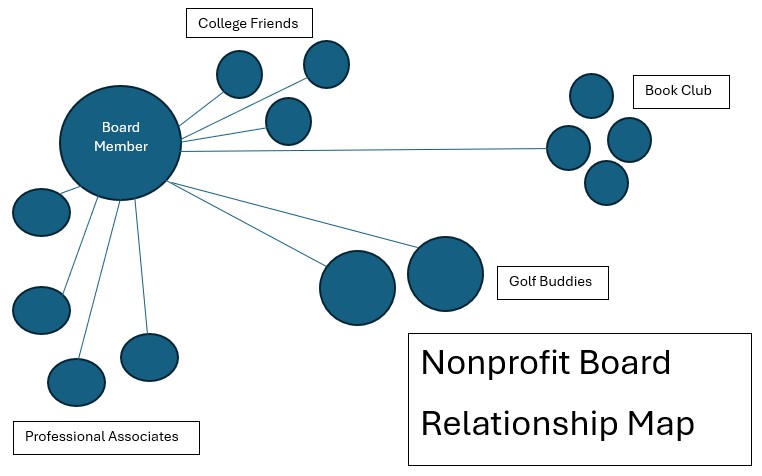
What a Relationship Map Looks Like 

Your finished map should be a visual diagram of circles and lines that connect each board member to the people in their circles of influence and looks a bit like this:

Courtesy: givingusa.org

Source: https://givingusa.org/board-engagement-mapping-your-board-for-fundraising-success/ 

Methodist Healthcare Ministries Opens Request for Proposals (RFP) for 74-County Environmental Scan & Analysis 

(San Antonio, TX October 29, 2024) – In 2024, Methodist Healthcare Ministries of South Texas, Inc.(MHM) is seeking proposals from qualified partners to conduct an environmental scan and assist with a SWOT analysis to be utilized as key strategic planning inputs for its 74-county service area. Interested entities have until November 12 to submit a proposal. 

The primary objective of the environmental scan is to systematically gather, analyze, and assess external environments to identify barriers and facilitators to health and well-being across MHM’s service area. By identifying both barriers and facilitators, the scan aims to inform the strategic plan as a priority, along with having some influence on policy and practice to better address well-being challenges within the community and priority areas. 

The preferred approach will include identifying and analyzing external macro environmental factors impacting health outcomes utilizing the STEEPLE framework. As such, the successful environmental scan will include factors influencing public health outcomes including examining broader social, technological, economic, environmental, political, legal, and ethical trends and developments.  

“This exciting project will go a long way to helping inform and direct where MHM directs its resources and attention in the coming years as we strive to fulfill our mission of ‘Serving Humanity to Honor God,’” said Jaime Wesolowski, President & CEO of Methodist Healthcare Ministries. 

The resulting scan and analysis will be utilized, along with a SWOT analysis, for identifying new opportunities and prioritizing strategies that are in alignment with MHM’s focus on health equity. The partner selected will provide curated data, analysis, thought leadership, and recommendations to support the development and successful implementation of tools for strategic planning activities including goal setting, visioning, and prioritizing strategic initiatives.  

To view the RFP, visit MHM.org or click here.  Interested applicants with questions should contact Sandra Martinez, Vice President of Strategy and Partnerships at smartinez@mhm.org.

MHM believes that to improve the wellness of the least served and fully live out its mission of “Serving Humanity to Honor God,” it must recognize the inequities inherent in its communities that contribute to poor health outcomes. Health Equity is both the process and goal by which MHM seeks to carry out that purpose. Health Equity is a framework of thought and action that strives to reduce racial and socio-economic disparities and create fair and just opportunities for every person to reach their full potential for health and life and contribute to that of others.

### 

About Methodist Healthcare Ministries of South Texas, Inc. 

Methodist Healthcare Ministries broadens the definition of health care by providing low-cost clinical care for the uninsured and by supporting community-led efforts that improve living conditions that cause people to be sick in the first place. We use our earnings as co-owners of Methodist Healthcare to ensure that people who are economically disadvantaged and uninsured can live their healthiest lives. We do this by advocating for, investing in and providing access to quality clinical care and addressing factors that affect health—including economic mobility, supportive relationships, food security, broadband access, and safe neighborhoods. Ultimately, we fulfill our mission of “Serving Humanity to Honor God” by advancing health equity so that more resilient individuals & families living in the 74 counties we serve can thrive. 

Invisible Wounds: Suicide Prevention Month

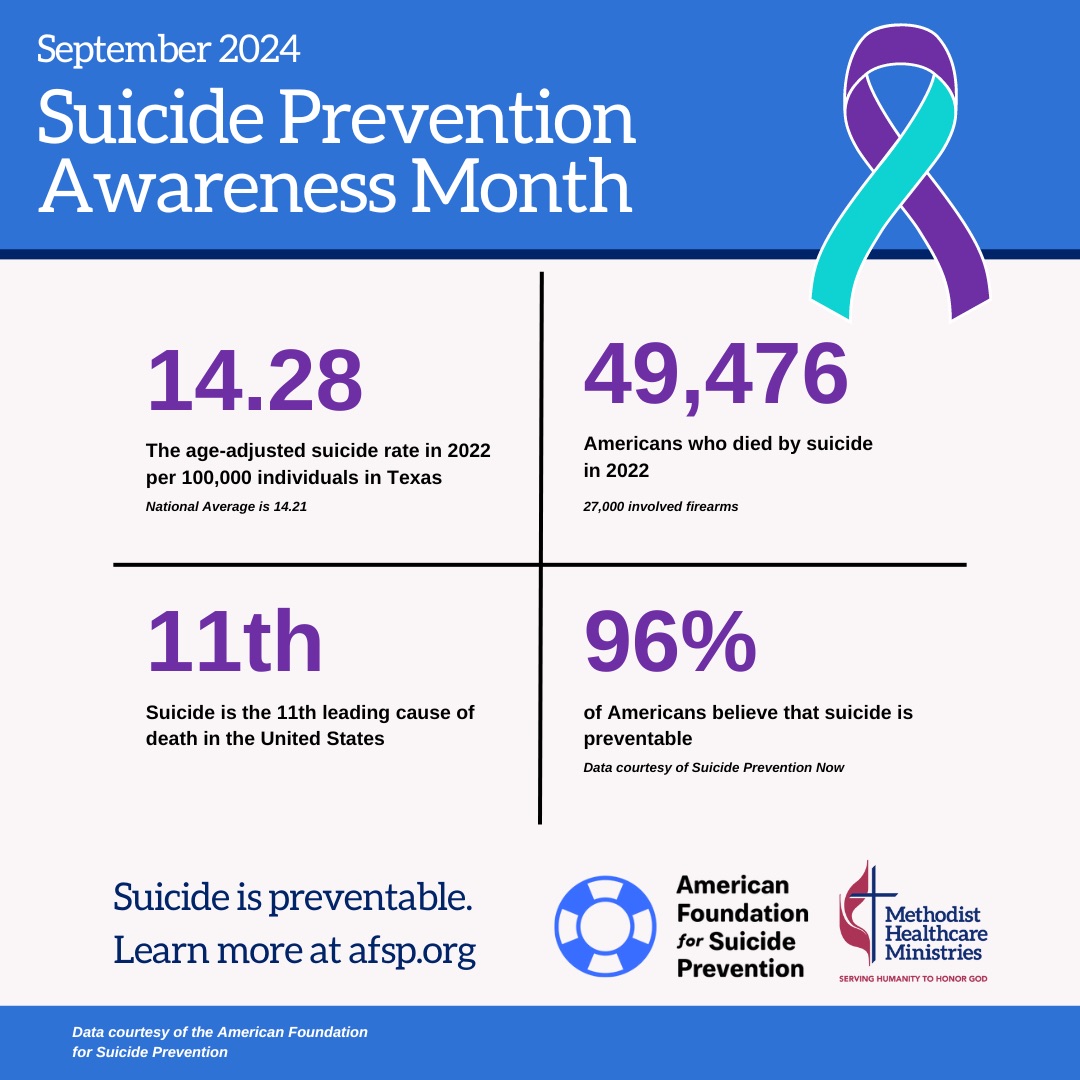
Some wounds are invisible. Those are the words used to best describe the struggle of the 49,476 people who died by suicide in 2022. Each of those individuals were precious to their families and friends and sadly the loss of those loved ones often creates a ripple effect of trauma and sorrow in the space those lives used to fill. 

According to the Centers for Disease Control and Prevention (CDC), suicide remains to be a silent killer in the U.S. In 2022 there were over 12.3 million people who seriously considered an attempt. The rise in self-harm related deaths and attempts goes back over 20 years with a 36 percent increase in suicide-related deaths in the U.S. since 2001. 

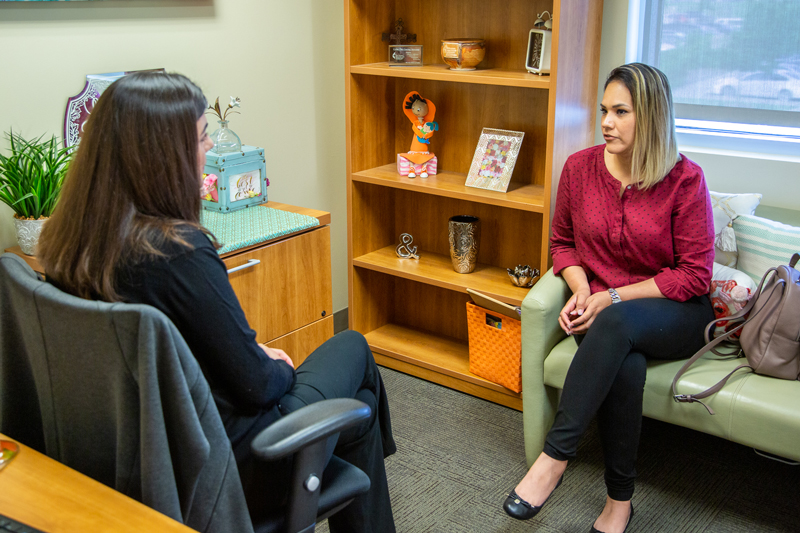
“It’s a dark subject that individuals don’t want to talk about,” said Celina Gonzalez, a supervisor in Methodist Healthcare Ministries’ Behavioral Health Services. “How do you talk to somebody who has experienced attempts or how do you talk to somebody who has had a family member die by suicide attempt?” 

Methodist Healthcare Ministries (MHM) approaches suicide prevention in its clinical and community care settings through an integrated care model that ensures individuals seeking help are supported in all aspects of their health – physically, mentally, and spiritually.  

This means recognizing that regardless of the reason for a visit, our medical and dental care providers are also asking patients questions that gauge the need for a referral to our behavioral health team to follow up and provide mental health treatment.  

“We approach it very carefully, very kindly, and very authentically,” Gonzalez said. “We create a safe space where someone can just unload what it is they’re experiencing.”  

Our clinical team members use the Patient Health Questionnaire (PHQ-9), a self-administered test provided in primary care settings to determine if patients might need mental health services. The completion of this questionnaire alerts our providers to any needs a patient or client may have outside of their scheduled appointment, which could range from medical, dental or behavioral health. A key element of this integrated care approach is MHM’s Behavioral Health team responding to any emergency room (ER) report notifying them when a MHM patient and registered client has been brought to an ER for mental health reasons. At this point, the behavioral health counselors’ step in and work with the or patient to create a safe space where they can discuss their situation.  

“Every year, we work with our families to complete a PHQ-9,” Andrea Aguirre, Parenting Program In-Home Specialist, said. “We do this to ensure that all our families get the necessary and lifesaving assistance they need.” 

Awareness and prevention are key factors for preventing someone who is experiencing suicidal ideation from becoming another tragedy. Being able to spot the signs that someone may be experiencing suicidal ideation and supporting that individual by connecting them to resources and providing a safe place to share their struggle is an important aspect of preventing suicide. Here are some signs to look out for:  

  • Withdrawing from family and friends and self-isolating  
  • Talking about feeling trapped in unbearable pain  
  • Acting anxious and aggressive  
  • Talking about being a burden to others  
  • Sleeping too much or too little  
  • Increased use of drugs and alcohol.  

Suicide Prevention Month is an internationally recognized observance established in 2003 to address the growing number of suicide-related deaths and to impart the singular message that suicide can be prevented. Additionally, suicide remains to be a leading cause of death in the United States for individuals aged 10 to 65 with death rates growing rapidly for young and economically disadvantaged individuals who may not have access to critical mental health services. 

If you, or someone you know, is struggling with depression or thoughts of suicide call the 988 Suicide and Crisis Lifeline for free help from mental health professionals.  

For more information on our services and how to get access to care, click here to learn more.

Methodist Healthcare Ministries Announces the Addition of Three New Board Members to its Board of Directors  

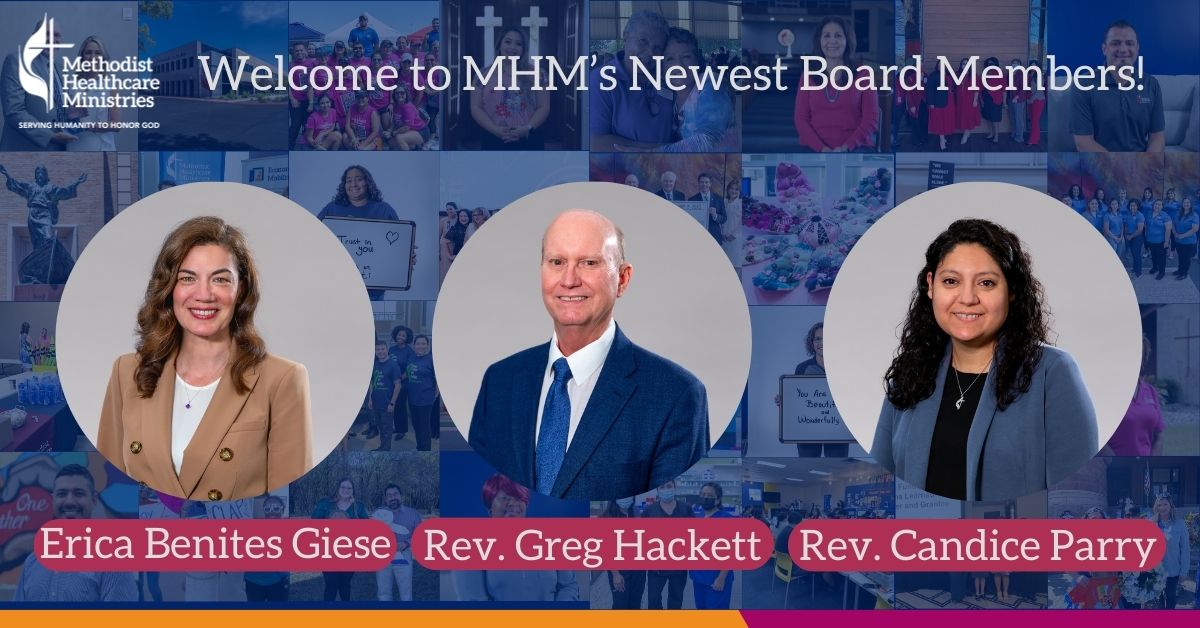
San Antonio (July 9, 2024) – Methodist Healthcare Ministries of South Texas, Inc. (MHM) announced the addition of three new members to its board of directors who guide the nonprofit organization that has been dedicated to improving the well-being of the least served since 1995. New board members began their three-year term on June 26.    

“I am honored to serve on this board with an incredible group of caring servants, equally committed to helping this organization advance health equity so that more people throughout the 74 counties we serve can reach their fullest potential for health and life,” said Michael Porter, newly elected Chair of the Board of Directors for Methodist Healthcare Ministries. “I am excited to welcome these outstanding and gifted individuals to our board and look forward to seeing the impact they will surely impart on this organization as it heads into its 30th year of ‘Serving Humanity to Honor God.’”  

The three new board members include:  

  • Erica Benites Giese – Attorney at Jackson Walker  
  • Rev. Greg Hackett – Retired pastor with the Rio Texas Conference of the United Methodist Church 
  • Rev. Candice Parry – Pastor at the First United Methodist Church of Carrizo Springs 

Rev. Hackett is returning to serve on the board of MHM after previously serving from 2017 to 2023. The other two members are new to the board and organization.  

MHM Board Members play a vital role in setting the direction and guiding the organization to advance a more level playing field for health in 74 counties across Texas. Since 1995, Methodist Healthcare Ministries has provided more than $1.67 billion in health care services through its clinical programs, as well as through partnerships, and is one of the largest private funding sources for community health care to low-income families and the uninsured in South Texas. As 50-50 co-owner of Methodist Healthcare, MHM board members play an important oversight role in the governance of the healthcare system ensuring it provides quality care to all regardless of ability to pay. The earnings from the co-ownership of the health system allows Methodist Healthcare Ministries to fund efforts that strengthen communities and families, provide clinical care to the uninsured and the economically disadvantaged, and promote a more level playing field for healthy living—now and for generations to come.  

Board members serve three-year terms and may serve up to three consecutive terms. In addition to serving on the general board, they also serve on one standing committee, such as the Executive Committee, Finance Committee, Governance Committee, Mission Committee, Investment Committee and Operations Committee. The board currently has 26 regular board directors and can have no more than 27 regular board directors at a given time. The board bylaws also dictate that at least 60 percent of the Regular Directors be members of The United Methodist Church.  

“Methodist Healthcare Ministries is broadening the definition of health care as we continue our efforts to advance health equity throughout the communities we serve,” said Jaime Wesolowski, President & CEO of Methodist Healthcare Ministries. “These new board members will bless us with the leadership and the unique talents they will impart in the coming years, as we strive to improve the lives of the least served so all have an opportunity to thrive.”  

###  

About Methodist Healthcare Ministries of South Texas, Inc.  

Methodist Healthcare Ministries broadens the definition of health care by providing low-cost clinical care for the uninsured and by supporting community-led efforts that improve living conditions that cause people to be sick in the first place. We use our earnings as co-owners of Methodist Healthcare to ensure that people who are economically disadvantaged and uninsured can live their healthiest lives. We do this by advocating for, investing in and providing access to quality clinical care and addressing factors that affect health—including economic mobility, supportive relationships, food security, broadband access, and safe neighborhoods. Ultimately, we fulfill our mission of “Serving Humanity to Honor God” by advancing health equity so that more resilient individuals & families living in the 74 counties we serve can thrive. 

MHM invests over $180 million to advance health equity across South Texas

(San Antonio, TX April 15, 2024) – In 2024, Methodist Healthcare Ministries of South Texas, Inc. (MHM) is investing $181.1 million to advance health equity, strengthen communities and impact systemic change across its 74-county service area. That amount includes direct services, community investments, the development of community partnerships and advocacy initiatives that create a more level playing field for individuals to thrive. The organization’s 2024 commitment represents an increase of 21% from its 2023 investment.  

That $181.1 million propels a strategic focus on advancing health equity, the framework of thought and action guiding the organization’s efforts to address systemic inequities and socio-economic barriers that keep people from living their healthiest lives.   

“At Methodist Healthcare Ministries, we are realizing our bold mission of ‘Serving Humanity to Honor God’ through the programs and services we offer, the diverse geography we cover and the incredible communities we serve,” said Jaime Wesolowski, President & CEO of Methodist Healthcare Ministries. “This investment is a clear reflection of the various ways our board of directors and our 500+ team members are broadening the definition of health care every day for patients, clients, and communities we serve.​”

MHM’s mission also includes its one-half ownership of Methodist Healthcare—the largest healthcare system in South Texas. The ownership structure ensures Methodist Healthcare continues to be a benefit to the community by providing quality care to all, and earnings to MHM to care for the uninsured and economically disadvantaged throughout its 74-county service area. 

MHM allocates its $181.1M budget across various key areas of investment- Grants, Strategic Operating Initiatives, Direct Services, and administrative costs that support these areas. This allocation ensures the organization delivers on its mission, vision, and strategy effectively. To ensure its investment has the highest level of community impact, MHM has consistently kept its administrative expenses below 15% – which is required to receive the highest possible score from Charity Navigator for analysis.

Grants: 

For 2024, MHM has apportioned $54.5 million in community grants to over 174 nonprofit organizations and municipalities. MHM’s goal is to help create and sustain healthy communities by supporting organizations that address the community conditions in which we are born, grow, live, and work, otherwise known as the Social Determinants of Health (SDoH).

MHM aims to help create and sustain healthy communities by supporting grant recipients addressing one of the following priority areas: access to care, mental and behavioral health; digital equity; food security; housing; education and workforce development. 

MHM’s grantmaking strives to deepen collaborative efforts, incentivize quality health outcomes, leverage and strengthen health care delivery systems and promote sustainable systems change. $7.7 million was awarded to organizations focused on addressing issues that are upstream, meaning MHM is intentionally addressing conditions and circumstances that affect the health and well-being of patients and clients before they might reach out to MHM, or its partners, for assistance. $6.1 million in grant funding was directed to rural communities, furthering efforts to support organizations outside of urban areas.  

An example of MHM’s support for its funded partners in action is evidenced in the work of SA Digital Connects. In 2024, SA Digital Connects received a $110,000 grant to support staffing for programming and implementation of the San Antonio and Greater Bexar County Digital Equity Plan. The goal of the plan is centered around closing the digital divide and facilitating 1) increased access and affordable adoption of digital devices/services, 2) digital devices distribution, and 3) digital literacy programming to assure internet safety. The project is projected to serve 500,000 individuals throughout the life of the grant and special attention is to be devoted to assisting unserved and underserved areas to ensure every household is connected to high-speed, reliable and affordable internet.

“The impactful work by Methodist Healthcare Ministries across San Antonio and Bexar County, continues to demonstrate their commitment to addressing the many challenges of the digital divide,” says Rhia Pape, Executive Director at SA Digital Connects. “We are proud to be supported and funded by MHM and other private sector partners and are thankful SA Digital Connects gets to work with such amazing partners to implement the SA/Greater Bexar County Investment Plan. There are many layers to this work and it’s only with coordination and collaboration between organizations that we will see success in closing the digital divide in our community.”

Strategic Operating Initiatives: 

In addition to the annual grants to partners, MHM has allocated nearly $28 million toward strategic initiatives that amplify its overall strategic goals and disrupt the cycle of intergenerational poverty. MHM is investing in approaches that address the root causes of poverty and health inequities, such as cross-sector partnerships, investing in community infrastructure, policy/legislative action eliminating barriers and/or addressing the long-term needs of individuals, families and communities. Examples of the types of initiatives MHM is investing in include: economic mobilityaccess to clean water, and community-led collaboration initiatives

Direct Services 

Creating access to care through the provision of clinical services has always been key to the organization’s mission. MHM operates two San Antonio-based primary health care clinics: Wesley Health & Wellness Center and Dixon Health & Wellness Center, and two school-based health centers: George Ricks School Based Health Center at Krueger Elementary and George Ricks School Based Health Center at Schertz Elementary. The clinics address the needs of low-income families and the uninsured by providing services at no cost or on a sliding fee scale. The health care services MHM provides are a cornerstone of its charitable purpose of creating access to care. Additionally, MHM offers health care services and programs throughout its 74-county service area including community counseling services, Community Health Worker program, Get FIT prevention program, parenting support groups and care coordination and referrals through its Wesley Nurse program. 

Since inception, Methodist Healthcare Ministries has provided more than $1.67 billion in health care services through its clinical programs, as well as through partnerships, and is one of the largest private funding sources for community health care to low-income families and the uninsured in South Texas.  

### 

About Methodist Healthcare Ministries of South Texas, Inc. 

Methodist Healthcare Ministries broadens the definition of health care by providing low-cost clinical care for the uninsured and by supporting community-led efforts that improve living conditions that cause people to be sick in the first place. We use our earnings as co-owners of Methodist Healthcare to ensure that people who are economically disadvantaged and uninsured can live their healthiest lives. We do this by advocating for, investing in and providing access to quality clinical care and addressing factors that affect health—including economic mobility, supportive relationships, food security, broadband access, and safe neighborhoods. Ultimately, we fulfill our mission of “Serving Humanity to Honor God” by advancing health equity so that more resilient individuals & families living in the 74 counties we serve can thrive. 

Capacity Building Series: Learning About Your Board & Growing Board Fundraising Engagement 

When it comes to getting your board engaged in fundraising, it’s important to consider who is on your board and why they’ve joined. Understanding more about your board members, such as why they are inspired to serve on your board, could indicate how they can support your organization’s fundraising strategies. Learning what inspires people, especially board members, can lead to higher engagement and enthusiasm from your board and cultivate stronger partnerships between staff and board members.

Who is in the seat? How to prepare your board to make impactful and meaningful decisions. 

First, let’s think about who is on your board. Boards are unique and have different dynamics—they vary in size, service term requirements, qualifications needed to serve on a board, communication styles, giving and receiving feedback, emotional intelligence, etc. Consider the diversity of your board when it comes to race, ethnicity, gender, age, geography, personal and professional backgrounds, etc. Does the diversity of your board reflect the community your organization serves? How can the diverse perspectives of board members be utilized to further your organizational mission? Could your board be more diverse? If so, how? These can all be helpful questions to reflect on. Diversity can bring a lot of benefit to the table through knowledge, different perspectives, lived and living experiences, connections, and more.

Every organization has different expectations of board members. For example, boards may have policies regarding minimum financial contributions (100% board giving, for example) or not have any policies at all about fundraising. Be up front about your expectations as your organization continues to recruit for new board members. When new board members join your organization’s board, prepare them for success. This could entail providing your board bylaws (if you have them), implementing a service agreement, and most importantly, providing trainings to board members about their roles and duties, fiduciary responsibilities, fundraising expectations, etc. When conducting the trainings, provide as much clarity and consistency as possible to get everyone on the same page. When it comes to fundraising, also keep in mind that board members who come from corporate backgrounds might need a general education about how nonprofits work and how they are different from for-profits. 

It can also be helpful to think about committees on your board. What are the committees, if any? Does your board have a fundraising/development committee? Having committees can help drive focus, action, and progress toward your objectives.

Why do they care? Aligning with your organization’s board 

Devote time and connect with individual board members to understand why they joined the board. Their passion for the organizational mission is what they have in common with you, your staff and other board members; lean into this shared connection. Board members are natural advocates of the organization and its mission, which organically leads them to engage in fundraising efforts. When board members are having conversations with people about something they care about (your organization), it can feel a lot less like work or a hassle, and more like speaking from the heart.

Creating the Foundation

Once you’ve connected with your board members and built strong relationships, it’s time to lay the foundation for your board’s engagement in fundraising. 

Here are some steps you can follow to build that foundation:

  1. Make sure that all members are clear on the board’s fundraising
    responsibilities. 
  2. Develop a fundraising plan for your organization with input from both board and staff. 
  3. Dispel early on any myths or concerns your board members may have about fundraising.
  4. Be clear that asking for money is not the only fundraising task that board members can be involved in. 
  5. Make the fundraising ask easy by thoroughly preparing your board members and providing them with relevant information they can communicate to prospective donors.
  6. Provide your board members with fundraising training/assistance.
  7. Set up a board development committee with orientation & training about board members’ duties, fiduciary responsibilities, fundraising, etc.
  8. Provide each board member with a concrete opportunity to contribute to the organization’s fundraising efforts.

Check out the board vs. staff responsibility checklist in this resource below from Community Change! It could help your organization gain more role clarity between board and staff members. Sources: http://www.campusactivism.org/server-new/uploads/boarvst.pdf and Community Change

You might also want to consider what your policies for board members are when it comes to board member donations/contributions. There are at least two common issues with this type of policy because it can:

  1. Exclude people with fewer financial resources, who might not be able to meet that minimum, from serving on the board.
    1. Limit the amount given by board members who are affluent and may interpret that minimum as the maximum. A board member who may have been prepared to give $10,000 might see a $1,000 minimum and only make the minimum required donation. Source: https://thecharitycfo.com/3-tips-for-successful-board-development/

Remember: your board members are fundraisers, advocates, supporters, and advisors that champion your mission. Given that there is a natural partnership that boards and nonprofit staff can maximize, fundraising is simply an extension of that partnership. Getting your board engaged in fundraising might not always be easy, but it can be as simple as starting there.

MHM Provides New Laptops to Cesar E. Chavez Legacy & Educational Foundational Scholarship Winners

San Antonio, TX (March 31, 2024) – Methodist Healthcare Ministries (MHM) is providing a new Dell laptop to 20 scholarship recipients selected by the César E. Chavez Legacy & Educational Foundation (CCLEF). The announcement was made at the annual César E. Chávez Day Águila Awards Gala, held Saturday, March 24 at Brooks Hanger 9. The César E. Chávez Day Águila Awards Gala concludes the César Chavez Day Celebration which began earlier that day with the 28th Annual Cesar E. Chavez March for Justice.

MHM sponsored the events for the first time in 2024 as CCLEF’s goals are closely aligned with its priorities, including addressing food insecurity, the digital divide, access to healthcare, voting rights and wage disparities. In 2023, the scholarship recipients expressed to CCLEF a need for laptops in preparation for their continuing education goals.

The COVID-19 pandemic underscored the widening digital divide, especially for students who did not have internet access at home, or the hardware needed to participate in virtual learning environments. The laptop donation is one small step towards closing that gap for these students.

“These inspiring students deserve every opportunity to reach their fullest potential for health and life and we are proud to provide them with one of the key resources they’ll need to reach for the stars,” said Jaime Wesolowski, President & CEO of Methodist Healthcare Ministries. “On behalf of our board of directors and the entire team at MHM, I congratulate these students on this special recognition, and we wish them success on their education journey.”

Each of the 20 students is receiving a $2,500 scholarship. Scholarship applicants submitted a letter of recommendation, an essay or poem, a copy of their high school transcripts, and an acceptance letter to an accredited community college, university, trade school or culinary school to be considered.

Ernest J. Martinez, Chairman of the César E. Chavez Legacy & Educational Foundation added “With the digital divide that is impacting families in underserved communities, bridging the gap to technology access is critical to learning, and having this kind of support from the Methodist Healthcare Ministries Familia is a community  win for students.”

The celebration follows the Cesar E. Chavez March for Justice, which honors the farm workers who help to feed our nation. The March for Justice has taken place in San Antonio since 1997 and this year marks the 28th anniversary. The march is co-sponsored by the City of San Antonio and organized by the Cesar E. Chavez Legacy & Educational Foundation.

###

About Methodist Healthcare Ministries of South Texas, Inc.

Methodist Healthcare Ministries broadens the definition of healthcare by providing low-cost clinical care for the uninsured and by supporting community-led efforts that improve living conditions that cause people to be sick in the first place. We use our earnings as co-owners of Methodist Healthcare to ensure that people who are economically disadvantaged and uninsured can live their healthiest lives. We do this by advocating for, investing in and providing access to quality clinical care and addressing factors that affect health—including economic mobility, supportive relationships, food security, broadband access, and safe neighborhoods. Ultimately, we fulfill our mission of “Serving Humanity to Honor God” by advancing health equity so that more resilient individuals & families living in the 74 counties we serve can thrive. 

About Cesar E. Chavez Legacy & Educational Foundation

Over the years, through the generosity of individual donors, public sector, and the corporate community, CECLEF has focused on the mission of serving others. To Preserve the Life & Legacy of César E. Chávez, whether it is providing college scholarships to our youth, or giving back to families through our annual Thanksgiving & Christmas in the Barrio events in the inner-city West Side of San Antonio, we encourage the youth of our community to Engage in Civic Participation, Advocate for Social & Economic Justice, and Graduate from College. As we continue with the CECLEF traditions, we keep the spirit of César E. Chávez alive and well in San Antonio. ¡SI SE PUEDE!


Capacity Building Series: Taking Peer Relationships One Step Further – Tips for Collaborating with Organizations

How to Approach and Build Collaborations

In our last blog, we explored collaborative peer relationships. We shared why and how nonprofits might collaborate with each other—the benefits, reasons, and methods of collaboration. We now want to dive a little deeper into what collaboration could look like for nonprofit organizations. Let’s keep in mind that the goal of collaboration is not always to write a collaborative grant, but it could be, if it’s what might be best for your organization. Sometimes it’s even more beneficial to partner with other organizations—and funders—to seek out more funding and maximize your impact on your community.

“Most funders and nonprofits value working together, and many are looking for ways to improve the quality of their collaborations. Even if some of what we try doesn’t work, deepening relationships with grantees and other stakeholders builds a strong foundation for future efforts. With the right conditioning and enabling environment, we can make progress on effectively partnering with others to achieve meaningful impact.”  Source: https://www.geofunders.org/resource/what-are-the-different-ways-to-collaborate/

Here are Some Tips for Collaborating with Organizations:

  1. Tie collaboration into your organization’s goals:
    • Be clear on your goals and how collaborating can help you achieve them.
  2. Determine how you fit into the landscape:
    • Learn more about the subject matter, issues being addressed by the collaboration, other collaborators, and the roles they play.
    • Ask yourself, “What role do we want to play? Where can we add value?”
  3. Lay the groundwork through relationship building:
    • Time to utilize those relationship building skills we discussed in our previous blogs (linked below)! Be intentional about developing trust by showing your flexibility, ability to compromise, and communicating openly about your community’s needs and how a collaboration can make a meaningful impact.
  4. Build a diverse and committed leadership:
    • Having a diverse staff and board that’s representative of your community helps provide a variety of perspectives and connections that can strengthen your network, and therefore your collaborative.
    • Get your staff and board on the same page in prioritizing the collaborative. Make sure they have buy-in and get them involved.
  5. Focus on communication:
    • Communication is key, right? So, communicate often and well—both within and outside of your organization—to ensure everyone is aligned on the vision of the collaborative. Carve out space and time early on for your organizations to get to know each other. Having these connections can make it easier to talk openly about challenges and hold each other accountable.
  6. Provide the resources required:
    • Be mindful of the amount of time and money needed to invest into a collaborative as well as your team’s capacity to focus on it. Remember to secure funding appropriately to help cover the associated costs of a collaborative.
  7. Ensure that collaboration remains a priority:

How to Write a Successful Collaborative Grant (Just One Way to Collaborate!)

Collaboration takes many forms. Building relationships and partnerships might be all that your organization needs. However, if you find that exploring a collaborative grant with fellow organizations might advance your organization’s mission in impacting your community, we would love to provide support. If you’ve never applied for collaborative funding, that’s okay! We’ll break it down in a few steps.

Step one: Identify Partners

You’ll want to begin by identifying other organizations that could be great partners and reach out to them now. Great partners often address the same or similar challenges of your community, have similar mission, vision, values, and goals to yours to make a broader impact. Or maybe they have an entirely different approach to addressing the challenge that compliments and aligns with your organization’s goals.

Establishing trust and getting to know each other’s expertise and available resources takes time. You can think of developing a partnership as an ongoing part of your grantseeking efforts. You can start by appointing a team leader and establishing a workplan and project schedule. You then might assign roles and responsibilities and agree on how you’ll make decisions. It might also be helpful to designate one person to do the writing and have everyone read a draft and suggest edits.

Step Two: Establish Communication and Infrastructure

Although we know that frequent communication is critical, everyone communicates differently. Be sure to discuss communication approaches and ensure a strong infrastructure with tools that all organizations can utilize. There are many types of collaboration tools available online such as:

  • Project management software
  • Document sharing tools
  • Communication tools to stay in touch remotely via messages and video calls
    • e.g. Microsoft Teams, Google Hangouts, Skype
  • Time tracking tools

Step Three: Call on Community

When you’re concerned about a community issue, act. Let the needs of the community be your driving force rather than funding opportunities. Before searching for funders, consider which other organizations you can partner with to address the issue together, leaning on your respective viewpoints, assessing data, and brainstorming possibilities.

Step Four: Talk Money

Discuss money early on. After agreeing on an approach with your collaborative partners, create a budget that details what each partner needs in the collaborative. Without a clear and comprehensive budget being established, a collaborative proposal can fail. Although, remember that a collaborative project budget does not always completely fund an initiative, program, or personnel. This means that organizations who are part of the collaborative might have to seek additional funding to make collaborative efforts monetarily whole.

Step Five: Confront Discord

Confront discord right away and ensure that all partners commit to civil, honest discussion to address the issue. If you are unable to find a solution, strive to maintain ongoing relationships even if a partner organization decides to part ways with the collaborative. However, keep in mind that collaborative relationships are often very fluid and just because a partner needs to bow out doesn’t mean the collaboration is failing. Source: https://www.tgci.com/blog/2020/11/four-more-tips-collaborative-grant-proposals

Hopefully some of these tips and suggestions will help you in your collaborative journey. We know that collaboration can look different from one organization to another based on needs, goals, connections, and resources. Your organization might be newer to collaborative efforts and eager to learn and get started. Maybe your organization is more seasoned and experienced in collaborating with other organizations, or collaborative funding, and ready to dive a little deeper. Perhaps you’re somewhere in between! We can all learn much from each other’s experiences, no matter where we are in our journeys.

So, let’s chat! Tell us below…what has your experience been with collaborating with other organizations? Have you experienced any barriers to collaborating? Would trying a new approach to collaborating help address a barrier? What experiences have you had with collaborative grants? What was that like for your organization? What lessons did you learn?

————————

Learn more about what Methodist Healthcare Ministries’ Capacity Building team is doing to assist organizations in improving operations and performance through its Capacity Building blog series on mhm.org. If you have any questions, please email us at claurence@mhm.org.

To read previous entries in the Capacity Building blog series, see below:

Capacity Building Series: Relationship Building with Funders (Part I)

Capacity Building Series – Part II: Why Relationships Matter

Capacity Building Series: Building Collaborative Relationships

MHM.org author pics

About the author: Chloé Laurence (she/her)

claurence@mhm.org

With a professional background working in education, mental health counseling spaces, and the nonprofit sector, Chloé serves her community through education, advocacy, and capacity building. She utilizes her love of learning and connecting with people in her work as a Capacity Building Specialist at Methodist Healthcare Ministries to support and empower our funded partners. Her mission is to strengthen our partners’ organizations so they can continue their incredible work building health equity and serving underserved individuals.

6 Community Coalitions Selected for Methodist Healthcare Ministries’ Prosperemos Juntos Thriving Together Learning Collaborative

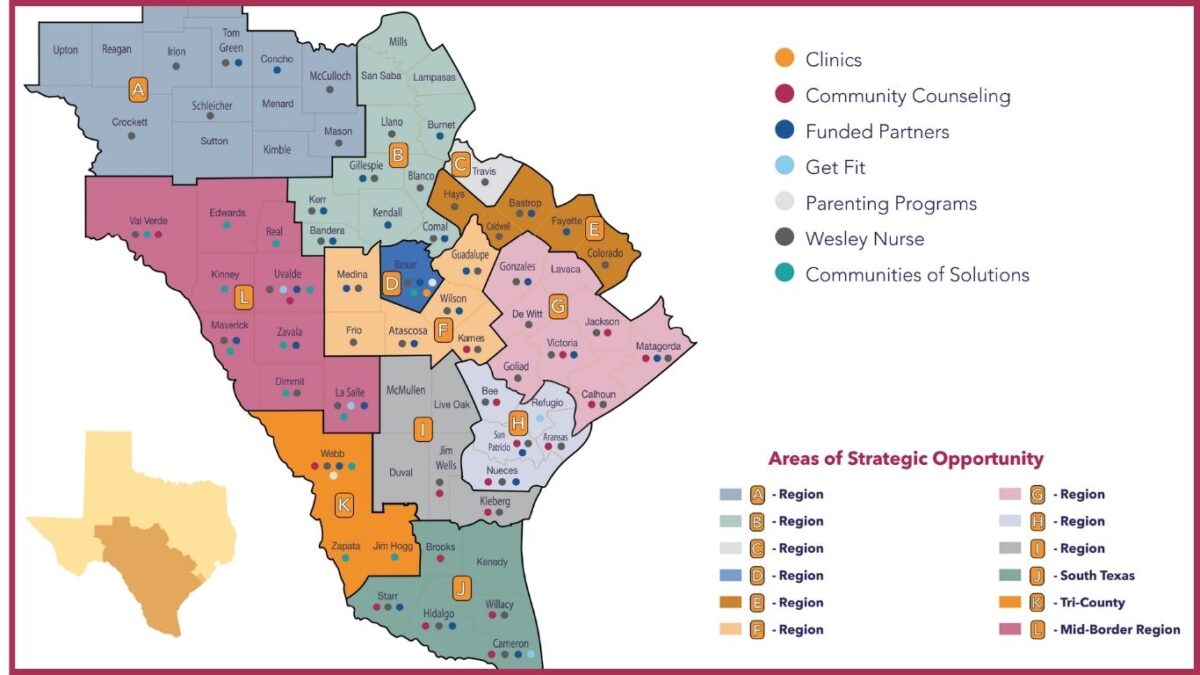
San Antonio, TX (March 19, 2024) – Six community coalitions from South Texas have been selected for the fourth cohort of Methodist Healthcare Ministries’ Prosperemos Juntos | Thriving Together (PJTT) Learning Collaborative. These coalitions are based in two geographic areas: the Mid-Border region (Dimmit, Edwards, Kinney, LaSalle, Maverick, Real, Uvalde, Val Verde, and Zavala counties), and the Laredo/Tri-County area (Webb, Zapata, and Jim Hogg counties). Beginning this month, they will embark on a six-month learning collaborative to explore different frameworks and equip themselves to develop and implement a health equity strategy for their community.

PJTT supports communities in shifting and sharing power to accelerate their journey toward health equity. Methodist Healthcare Ministries (MHM) strongly believes that communities are best equipped to improve their health and well-being. The ultimate goal of this collaborative is to provide coalitions with the knowledge and resources to strategically advance health equity, utilizing the Pathways to Population Health framework as a guide.

“The Prosperemos Juntos | Thriving Together program is one of the ways that we advance our strategic focus of strengthening communities and we are focusing our efforts on the counties and regions with the highest levels of inequities and poverty,” said Jaime Wesolowski, President & CEO of Methodist Healthcare Ministries. “This approach allows us to have a stronger and deeper level of engagement where we learn and co-create the solutions with people who live, work, pray, and play in the communities we serve.”

This is the fourth cohort of MHM’s PJTT Learning Collaborative. The first cohort was launched in 2021. The curriculum for the Learning Collaborative was developed in partnership with WE In the World. The coalitions selected for the cohort include:

Mid-Border Region

  • Community Empowerment Alliance
    • Election Nerds, Eagle Pass SAFE, Eagle Pass Firefighter Union Local 5490
  • Manos Unidas por la Dignidad
    • Maverick County Hospital District Foundation, El Consulado de Mexico/Ventanilla de Salud, Wintergarden Women’s Shelter

Laredo / Tri-County Area

  • Prosperity Alliance for Laredo
    • Laredo Chamber of Commerce Foundation, International Bank of Commerce, PNC Bank
  • Smiles from Heaven
    • Smiles from Heaven, Bondoc Security Services LLC, Christ Worship Center
  • Zapata Fuerte
    • Zapata County Public Library, Zapata Boys & Girls Club, Los Ebanos Apartments, Zapata County Indigent Care
  • Zapata Health Coalition
    • Texas A&M AgriLife Extension, Zapata Ryderz, Zapata CISD, Zapata County

During the learning collaborative, Methodist Healthcare Ministries’ Communities of Solutions (CoS) team supports the coalitions in developing a multi-sector collaboration that incorporates persons with lived experience of the challenges that the coalition is tackling into the coalition’s leadership team. The goal is for coalitions to identify and focus on one vital community condition (such as humane housing or reliable transportation) that contributes to the well-being of the entire community. Each coalition creates a strategic framework or plan of action for advancing health equity. The CoS team meets regularly with the coalitions, schedules monthly check-ins to build rapport and trust, and also offers support as the coalitions learn and grow.

After completing the Learning Collaborative, coalitions are invited to apply to the Implementation Phase. The Implementation Phase lasts 3 years and includes funding as well as capacity-building resources. Although coalitions will focus their time working in community, they will still be invited to collaborate with each other through convenings and learning.

For more information on the PJTT Learning Collaborative, visit: https://mhmbridgeofblessings.org/thriving-communities/.

###

About Methodist Healthcare Ministries of South Texas, Inc.

Methodist Healthcare Ministries broadens the definition of healthcare by providing low-cost clinical care for the uninsured and by supporting community-led efforts that improve living conditions that cause people to be sick in the first place. We use our earnings as co-owners of Methodist Healthcare to ensure that people who are economically disadvantaged and uninsured can live their healthiest lives. We do this by advocating for, investing in and providing access to quality clinical care and addressing factors that affect health—including economic mobility, supportive relationships, food security, broadband access, and safe neighborhoods. Ultimately, we fulfill our mission of “Serving Humanity to Honor God” by advancing health equity so that more resilient individuals & families living in the 74 counties we serve can thrive.

———————————————————————————–

Seis coaliciones comunitarias seleccionadas para el Colaborativo de Aprendizaje Prosperemos Juntos Thriving Together de Methodist Healthcare Ministries

San Antonio, TX ( 19 de marzo 2024) – Seis coaliciones comunitarias del sur de Texas han sido seleccionadas para la cuarta cohorte del Colaborativo de Aprendizaje Prosperemos Juntos | Thriving Together (PJTT) de Methodist Healthcare Ministries. Estas coaliciones se basan en dos áreas geográficas: la Región Fronteriza Central (condados de Dimmit, Edwards, Kinney, LaSalle, Maverick, Real, Uvalde, Val Verde y Zavala) y el área de Laredo/la región de los tres condados (condados de Webb, Zapata y Jim Hogg). A partir de este mes, se embarcarán en un colaborativo de aprendizaje de seis meses para explorar diferentes marcos y equiparse para desarrollar y aplicar una estrategia de equidad en la salud para sus comunidades.

PJTT ayuda a las comunidades a cambiar y compartir el poder para acelerar su camino hacia la equidad en la salud. Methodist Healthcare Ministries (MHM) cree firmemente que las comunidades están mejor equipadas para mejorar su salud y bienestar. El objetivo final de este colaborativo es proporcionar a las coaliciones los conocimientos y recursos necesarios para avanzar estratégicamente hacia la equidad en la salud, utilizando como guía el marco de trabajo de los Caminos hacia la Salud de la Población.

“El programa Prosperemos Juntos | Thriving Together es una de las formas en que avanzamos en nuestro enfoque estratégico de fortalecer las comunidades y estamos centrando nuestros esfuerzos en los condados y regiones con los niveles más altos de inequidades y pobreza”, dijo Jaime Wesolowski, Presidente y CEO de Methodist Healthcare Ministries. “Este enfoque nos permite tener un nivel de compromiso más fuerte y profundo en el que aprendemos y co-creamos las soluciones con las personas que viven, trabajan, orán y juegan en las comunidades a las que servimos.”

Esta es la cuarta cohorte del Colaborativo de Aprendizaje PJTT de MHM. La primera cohorte se lanzó en 2021. El currículo para el Colaborativo de Aprendizaje se desarrolló en asociación con WE In the World. Las coaliciones seleccionadas para la cohorte incluyen:

La Región Fronteriza Central

  • Alianza para el Empoderamiento de la Comunidad (Community Empowerment Alliance)
    • Nerds de las Elecciones (Election Nerds), La defensa de la sexualidad para todos en Eagle Pass (Eagle Pass SAFE), el Sindicato Local de Bomberos 4590 de Eagle Pass (Eagle Pass Firefighter Union Local 5490)
  • Manos Unidas por la Dignidad
    • Fundación del Distrito Hospitalario del Condado de Maverick (Maverick County Hospital District Foundation), El Consulado de Mexico/Ventanilla de Salud, Refugio para mujeres Wintergarden (Wintergarden Women’s Shelter)

Laredo / Región de los tres condados

  • La Alianza para la Prosperidad de Laredo (Prosperity Alliance for Laredo)
    • Fundación Cámara de Comercio de Laredo (Laredo Chamber of Commerce Foundation),Banco Internacional de Comercio (International Bank of Commerce), Banco PNC
  • Sonrisas desde el Cielo
    • Sonrisas desde el Cielo (Smiles from Heaven), Servicios de Seguridad Bondac LLC ( Bondoc Security Services LLC), Centro de Alabanza a Cristo (Christ Worship Center)
  • Zapata Fuerte
    • Biblioteca del Condado de Zapata (Zapata County Public Library), Club de niños y niñas de Zapata (Zapata Boys & Girls Club), Departamentos Los Ebanos (Los Ebanos Apartments), Atención médica para indigentes del condado de Zapata (Zapata County Indigent Care)
  • La Coalición para la Salud de Zapata (Zapata Health Coalition)
    • Texas A&M AgriLife Extension, Zapata Ryderz, Zapata CISD, el Condado de Zapata

Durante el colaborativo de aprendizaje, el equipo de Comunidades de Soluciones (CoS por sus siglas en inglés) de Methodist Healthcare Ministries apoya a las coaliciones en el desarrollo de una colaboración multisectorial que incorpora a personas con experiencia de vida en los desafíos que la coalición está abordando al equipo de liderazgo de la coalición. El objetivo es que las coaliciones identifiquen y se centren en una condición vital de la comunidad (como una vivienda digna o un transporte confiable) que contribuya al bienestar de toda la comunidad. Cada coalición crea un marco estratégico o plan de acción para promover la equidad en la salud. El equipo de Comunidades de Soluciones se reúne periódicamente con las coaliciones, programa reuniones mensuales de seguimiento para fomentar la relación y la confianza, y también ofrece apoyo a medida que las coaliciones aprenden y crecen.

Una vez finalizada esta etapa del Colaborativo de Aprendizaje, se invita a las coaliciones a solicitar su participación en la Fase de Implementación. La Fase de Implementación dura tres años e incluye financiación y recursos para el desarrollo de capacidades. Aunque las coaliciones centrarán su trabajo en la comunidad, se les seguirá invitando a colaborar entre los participantes mediante reuniones y actividades de aprendizaje.

Para más información sobre el Colaborativo de Aprendizaje PJTT, visite:https://mhmbridgeofblessings.org/thriving-communities/.

###

Acerca de Methodist Healthcare Ministries of South Texas, Inc.

Methodist Healthcare Ministries amplía la definición de asistencia sanitaria proporcionando atención clínica de bajo costo a los no asegurados y apoyando los esfuerzos dirigidos por la comunidad que mejoran las condiciones de vida que causan que las personas se enfermen en primer lugar. Utilizamos nuestras ganancias como copropietarios de Methodist Healthcare para garantizar que las personas con desventajas económicas y sin seguro médico puedan llevar una vida más sana. Para ello, defendemos, invertimos y facilitamos el acceso a una atención clínica de calidad y abordamos los factores que afectan a la salud, como la movilidad económica, las relaciones de apoyo, la seguridad alimentaria, el acceso a la banda ancha y las vecindades seguras. En definitiva, cumplimos nuestra misión de “Servir a la humanidad para honrar a Dios” fomentando la equidad sanitaria para que las personas y las familias que viven en los 74 condados en los que prestamos servicio puedan prosperar.

Inclement Weather Notice: Mar. 15 2024

March 15, 2024 (San Antonio, Texas):  A large portion of Methodist Healthcare Ministries’ service area is being threatened by severe weather later this afternoon (March 15).  MHM will be closing its San Antonio area owned facilities, including Corporate, Wesley Health & Wellness Center, Dixon Health & Wellness Center, George Ricks School Based Health Center at Krueger Elementary and George Ricks School Based Health Center at Schertz Elementary at 4 p.m.  Patients who had existing appointments after 4 p.m. will be rescheduled.

The safety of our patients, clients and team members is of utmost importance. Visit mhm.org for the latest updates.

###

About Methodist Healthcare Ministries of South Texas, Inc.

Methodist Healthcare Ministries broadens the definition of healthcare by providing low-cost clinical care for the uninsured and by supporting community-led efforts that improve living conditions that cause people to be sick in the first place. We use our earnings as co-owners of Methodist Healthcare to ensure that people who are economically disadvantaged and uninsured can live their healthiest lives. We do this by advocating for, investing in and providing access to quality clinical care and addressing factors that affect health—including economic mobility, supportive relationships, food security, broadband access, and safe neighborhoods. Ultimately, we fulfill our mission of “Serving Humanity to Honor God” by advancing health equity so that more resilient individuals & families living in the 74 counties we serve can thrive. 

White close icon

Jaime Wesoloski

President & Chief Executive Officer

Jaime Wesolowski is the President and Chief Executive Officer at Methodist Healthcare Ministries. A healthcare executive with three decades of leadership experience, Jaime is responsible for the overall governance and direction of Methodist Healthcare Ministries. Jaime earned his Master’s Degree in Healthcare Administration from Xavier University, and his Bachelor’s of Science from Indiana University in Healthcare Administration. As a cancer survivor, Jaime is a staunch supporter of the American Cancer Society. He serves as Chair of the American Cancer Society’s South Texas Area board of directors and he was appointed as Chair to the recently created South Region Advisory Cabinet, covering eight states from Arizona through Alabama. Jaime believes his personal experience as a cancer survivor has given him more defined insight and compassion to the physical, emotional, and spiritual needs of patients and their families.